
Detention Center Release Paths
A person can leave the Aransas County Detention Center for the community after bail is accepted, a court orders release, charges end with no other hold, or a county sentence and authorized credit are complete. The same physical departure can instead be a transfer. TDCJ, the U.S. Marshals Service, ICE, another county, or another facility may become the next custodian. A missing name or a statement that someone “left the jail” does not distinguish those outcomes.
Ask for the completed jail-register and booking-out entry. The key fields are the actual event date and time, release or transfer type, legal authority, and destination or receiving agency when recorded. A court order supplies legal context, but it may not prove that processing finished or all other holds cleared. The jail exit record and the operative order together provide the strongest local confirmation.
Confirm Detention Center Release
- Call the jail and ask whether the person is still physically held.
- If not, ask whether the recorded event was community release or transfer and request the event date.
- Request the jail-register entry, booking-out sheet, legal authority, and receiving agency.
- Match the cause number to the proper clerk and read the latest signed order or judgment.
- Follow any transfer into TDCJ, federal, immigration, or another county system.
Aransas County has no verified public current roster, 24-hour release feed, 72-hour feed, or online booking-photo list. Texas IVSS-Counties may provide an event or alert if Aransas participates and the person is available in the live portal, but its own data is not an official record. The detailed fallback chain on the Aransas County released-inmates search keeps each source in its proper role.
A court result does not answer every custody question. A bond order authorizes release on conditions but processing can remain incomplete. A dismissal on one cause does not clear another warrant. “Time served” can explain a release, yet another detainer may direct a transfer. Use the narrowest status supported by both the legal and physical-custody records.
Detention Center Records Contact
Call 361-790-0168 before visiting. The official page lists fax 361-790-0164. Its online contact form accepts attachments, warns against submitting Social Security, banking, payment, or driver's-license data, and sets limits of 5 MB per file and 20 MB total. Research did not identify it as a formal Public Information Act portal, so label a request clearly and follow the custodian's directions.
Physical address: 811 E. Concho, Rockport, TX 78382
Mailing address: 308 N. Live Oak Street, Rockport, TX 78382-2745
Jail information: 361-790-0168
Detention Center contact channel
Ask only for existing records. A useful request identifies the person and approximate booking date, then lists the jail register, booking-in and booking-out forms, release or transfer order, actual event time if recorded, receiving agency, property-return receipt, and booking photograph. Separate items let the agency release available material even if another item needs review or redaction.
Aransas County Jail Custody
The Aransas County Sheriff operates the county jail and is responsible for its prisoners. The Sheriff's official duties also include accepting bail for people in custody. No official bond schedule or accepted-payment-method sheet was found, so obtain the amount and authority from the case or magistrate and confirm completion with jail staff. Bail release leaves the criminal case pending and differs from discharge after sentence completion.
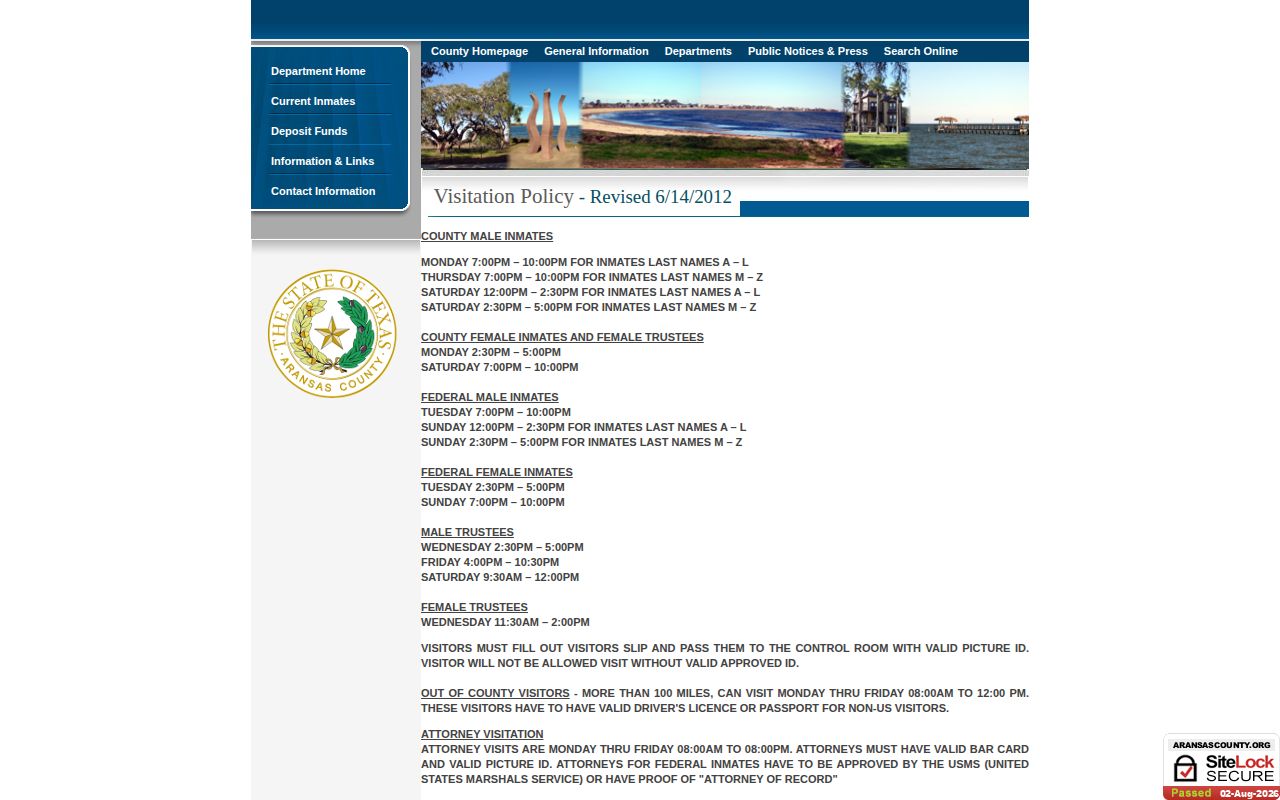
The facility also categorizes federal detainees in its visitation policy. That matters because federal housing can place a USMS detainee in the same building as a county detainee while the cases and release authority remain separate. The policy requires USMS approval or attorney-of-record proof for federal attorneys. It supports the existence of a federal detainee layer, but it does not establish who is housed there on a given day.
Which Aransas Address Applies?
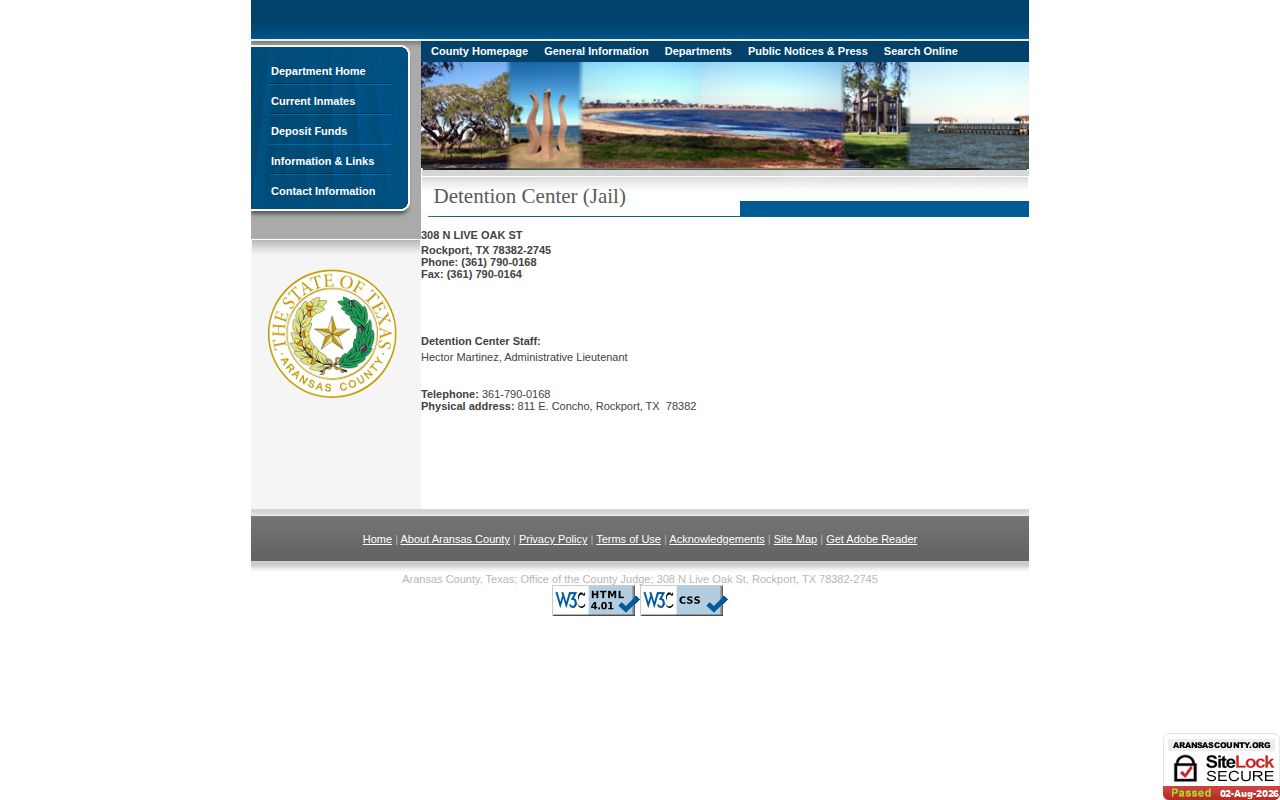
The official Detention Center page distinguishes addresses by function. It states 811 E. Concho as the physical address and displays 308 N. Live Oak as the mailing or county address. The Sheriff's public-safety office is a third location at 714 E. Concho. A mailed request, an in-person records visit, and an authorized release pickup may therefore involve different destinations.
Do not infer the release door or waiting area from a mailing address. Aransas County publishes no verified exit instructions, release-processing hours, weekend schedule, or family waiting location. Call the jail, ask whether processing is complete, and ask where an authorized pickup may wait. Label each address by function in notes so that a record request does not become a trip to the wrong building.
The image below comes from the official Detention Center page and shows the local jail identity and its address presentation.
Use that official page as the starting point, then call before relying on an address for a specific task.
Federal Detainee Release Distinction
The Detention Center visitation policy separately identifies county and federal detainees. For a federal person, leaving Aransas County's building may be a USMS move, a federal court release, transfer to BOP after sentence, or transfer to immigration custody. County staff can confirm the local exit, but the federal order and federal custodian determine the next status.
The official visitation page is shown below because it documents that local custody distinction.
This division is why every Detention Center exit record should be read for destination, not reduced to the single word “released.”
Aransas Release Record Retention
Texas State Library and Archives Commission Schedule PS makes the jail register a durable fallback. Record PS4200-06 describes it as including the prisoner's name, gender, intake number, reason for commitment, and date of release or transfer, with permanent retention. Booking-in and booking-out forms and release or transfer orders under PS4200-10 are retained for release or transfer plus two years. Property-return records have the same minimum, while transfer documents have a one-year minimum after transfer.
Those are government retention periods, not promises about an online roster. Aransas County publishes no verified roster archive or web retention window. The official Local Schedule PS explains the records categories that can be named in a focused request. Medical, juvenile, sealed, expunged, victim-identifying, and security-sensitive material may still be withheld or redacted under applicable law.
Finish the Aransas Release Check
Keep a short source log. Record when the jail was called, who owned each record, the cause number, and the date shown on the completed exit entry. If the court and jail dates differ, do not force them into one timestamp. A judge may sign an order before staff complete release processing. An IVSS notice may arrive later. The official record for each step should retain its own date.
When the destination is blank or unclear, ask the Detention Center to clarify whether the event code means release or transfer. Do not ask staff to speculate about a new custodian. Follow the named agency directly. This method keeps the final statement accurate and useful for reconnecting with someone, arranging transport, receiving notifications, or documenting a court process.