
Aransas County Parole and Probation Compared
Start with the judgment and custody history. Parole is conditional release from a TDCJ sentence and is administered through the TDCJ Parole Division after action by the Texas Board of Pardons and Paroles. Probation, commonly called community supervision in Texas records, comes from a trial court and is handled locally through the community-supervision system. Neither status can be inferred from the fact that someone left the Aransas County Detention Center.
| Question | Parole | Probation |
|---|---|---|
| Who orders or grants it? | The Board acts within the state-sentence framework. | The criminal court places the person on community supervision. |
| Who supervises it? | TDCJ Parole Division through the office assigned for Aransas County. | The local adult-probation or community-supervision department tied to the court. |
| Best verification record | TDCJ identity and sentence data, BPP decision information, then Parole Division confirmation. | The signed judgment or supervision order, court docket, and local probation-office confirmation. |
| How it ends | Discharge, revocation, or another outcome recorded under the state sentence. | Successful completion, early termination when ordered, revocation, or another court disposition. |
Verify Aransas County Post-Release Supervision
Use a source chain because no single public portal proves every form of Aransas County supervision. The TDCJ online search covers only people currently incarcerated in a TDCJ facility, so a missing result cannot prove that a former prisoner is discharged. Local probation is also a court matter, not a TDCJ parole record.
- Identify the case and last custodian. Match the full name with a cause number, SID or TDCJ number, birth details when lawfully available, and the conviction court.
- For possible parole, check TDCJ and BPP. Use the TDCJ Online Inmate Search for a current prisoner and the Board of Pardons and Paroles resources for review and decision context.
- Read dates as milestones. Eligibility, next-review, projected-release, and scheduled-release dates do not show that release occurred.
- For possible probation, read the court order. Use the Aransas County Clerk court map for misdemeanor routing or the District Clerk for felony dockets, then request the signed judgment or later order.
- Confirm the assigned office. Ask whether the person is actively supervised, discharged, transferred to another district, or subject to a pending court action. Staff may limit what they disclose.
- Reconcile custody. A jail release record shows physical departure; the supervision record shows what followed. The full named-person path is explained on the Aransas County released-inmate search.
Note: An alert or search result is a lead; the responsible court or supervision agency supplies the controlling status.
Aransas County Parole Office Routing
TDCJ routes Aransas County parole matters through its published county-to-district-office directory. The research identifies the Corpus Christi District Parole Office at 422 Sun Belt Drive, Corpus Christi, TX 78408, telephone 361-289-5720. Verify the assignment before visiting because a person may be transferred, placed in another district, or handled by a specialized caseload.
Supervision Contacts
Corpus Christi District Parole Office
422 Sun Belt Drive
Corpus Christi, TX 78408
361-289-5720
TDCJ Parole Division central office: 512-406-5250
BPP status line: 844-512-0461
Aransas County Adult Probation: 361-790-0116
The official TDCJ parole-office directory is the source for the Aransas routing shown below.
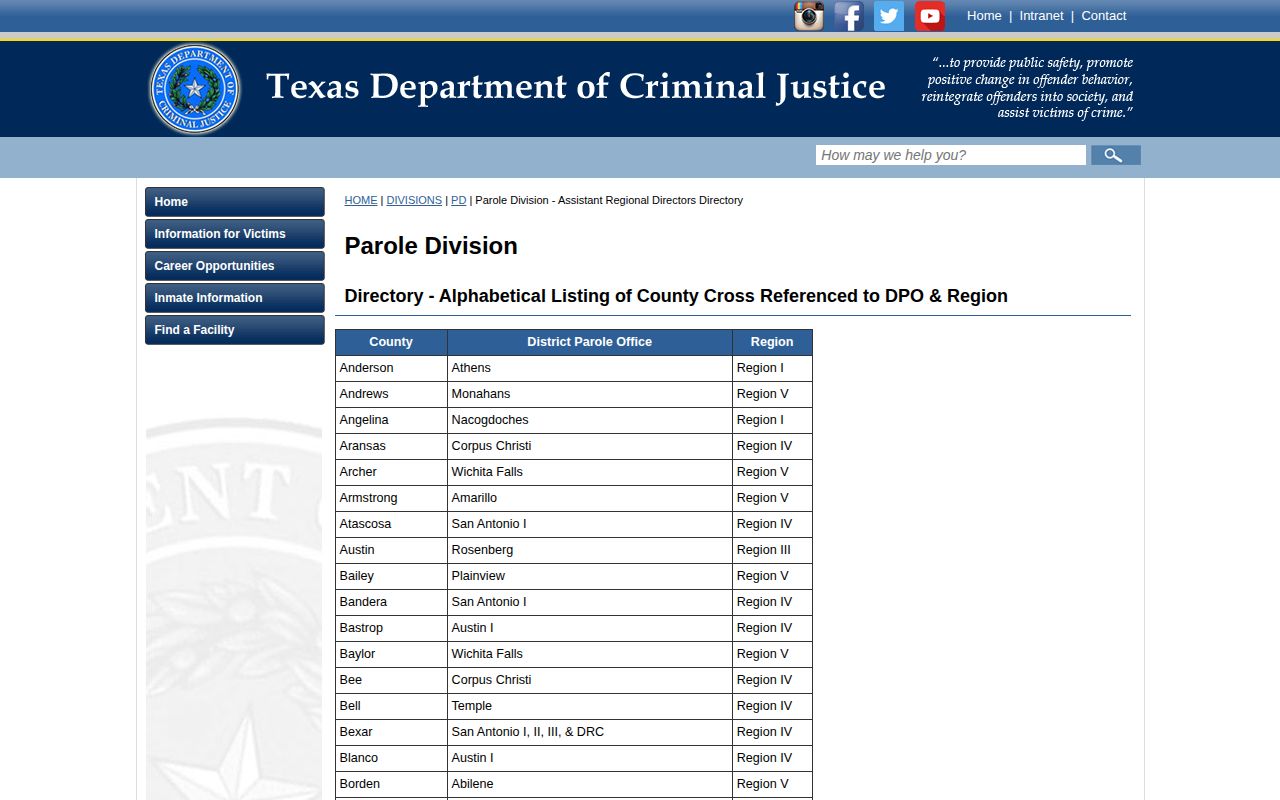
The directory helps locate the starting office, but the assigned officer or unit must confirm an individual case.
Aransas County Supervision Conditions and Violations
Conditions come from the governing parole certificate, court order, and case plan. They may require reporting, approved travel, treatment, fees, or other conduct, but the exact terms are individual. A missed appointment or alleged violation does not by itself show the final outcome. Parole staff may initiate a revocation process, while a probation matter returns to the sentencing court through a motion and judicial decision.
Separate three events: an allegation, a warrant or hold, and a final revocation or continuation order. If the person is arrested at the Aransas County Detention Center, obtain the new booking and identify the authority behind the hold. If the record instead shows transfer to TDCJ or another agency, that movement is continued custody, not a new release. Texas IVSS-Counties or TDCJ IVSS may provide notifications when the correct system and record are covered, but an alert is not a certified supervision record.
Parole revocation and probation revocation also follow different records. A BPP or TDCJ record belongs to the state-parole track. A motion, warrant, hearing, and signed order in the conviction court belong to the probation track. When a person is confined pending action, do not describe the custody as a completed revocation unless the deciding body has entered that outcome. Ask for the most recent dated status and the office or court that can confirm it.
How Aransas County Supervision Ends
A supervision end should be tied to a dated official record. For probation, look for a court order showing completion, early termination, revocation, or another disposition. For parole or mandatory supervision, use TDCJ incarceration history and Parole Division confirmation to distinguish active supervision from sentence discharge. A person can finish jail custody while supervision continues, and a person can finish one case while another warrant or sentence remains open.
Do not treat the TDCJ current-only search as a discharge archive. A former prisoner may no longer appear there. TDCJ's Inmate Information email route accepts a name in the subject and identifying details for listed incarceration information, while a formal Public Information Act request may be needed for other records. Court clerks remain the source for probation orders.
Aransas County Parole Review Is File Voting
Texas does not use a public formal-hearing calendar for ordinary parole and mandatory-release review. The Board explains that panel members review and vote the case file individually. Parole Division generally identifies cases about six months before initial eligibility and about four months before later reviews. An Institutional Parole Officer interviews the prisoner and prepares a summary, then a three-member panel votes in sequence; two matching votes ordinarily settle the result.
A result code needs careful reading. FI-1 and other FI codes are approvals with timing or program conditions. NR, SA, RMS, and DMS describe distinct outcomes under the Board's published vocabulary. Approval may point to a future eligible date or completion of a program. It is not a completed gate release. Denial can set another review or require service toward sentence expiration.
The BPP file-voting explanation documents the process illustrated below.
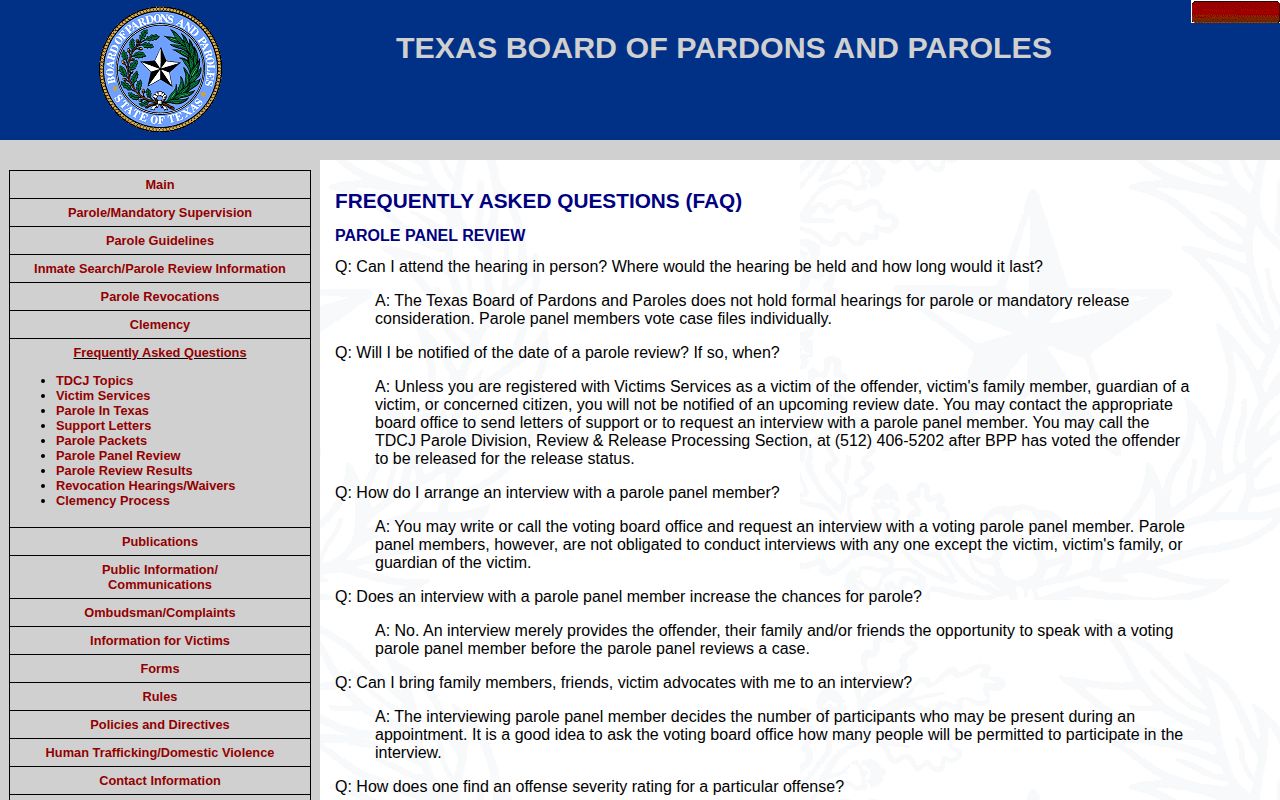
This process explains why a next-review date or favorable vote should be checked against later release planning and actual status.
Parole eligibility is likewise not a release prediction. Government Code Section 508.145 uses rules tied to offense categories and offense dates. Listed serious-offense or affirmative-finding cases generally require actual calendar time equal to one-half of the sentence or 30 years, whichever is less, before eligibility, without good time. Other covered cases generally use calendar time plus accrued good time equal to one-fourth of the sentence or 15 years, whichever is less, subject to exclusions. Mandatory supervision has separate rules in Sections 508.147 through 508.149. The judgment and controlling law must be read before interpreting any date.
Can an Aransas County Release Leave Another Warrant?
Yes. Aransas County Justice of the Peace Precinct 2 publishes outstanding-warrant material and has posted a warrant-roundup or amnesty notice. Those materials are not inmate-release lists, and a downloaded copy is not a self-updating warrant check. They illustrate a vital local point: release from one booking or cause does not erase a warrant issued in another matter.
Check the current JP2 source, then confirm with the court that issued the warrant. District, County Court at Law, justice-court, and Rockport Municipal Court cases have different clerks and jurisdictions. A parole or probation office may know of a supervision hold, but only the responsible authority can state whether a particular warrant remains active or has been recalled.
Note: A release entry proves an exit event for that booking; it does not clear every cause, warrant, or supervision hold.
A current warrant can also affect where someone goes after leaving the county jail. Delivery to another agency is a transfer, even if the local booking is closed. Ask the Detention Center for the exit classification and receiving agency, then check the issuing court or custodian. This avoids collapsing an Aransas County jail exit, a parole hold, a probation warrant, and a true community release into one inaccurate label.
For documentary proof, request the narrow record that answers the question. A jail-register or booking-out entry addresses the physical exit. A court docket and signed order address probation status. TDCJ incarceration history and Parole Division confirmation address a state sentence and conditional supervision. Keeping those records in their proper lanes reduces false matches and makes it clear when a later agency still has lawful custody.