
Aransas County Projected vs Actual Release
Three clocks can appear in an Aransas County case. A county-jail sentence uses the judgment, credit for time already held, actual days served, and any sheriff-authorized county good conduct. TDCJ's Projected Release Date is a calculated state milestone shaped by parole, mandatory-supervision, and discharge law. A Scheduled Release Date appears after approval and release planning, but TDCJ warns that it and the scheduled location can change without notice.
A pretrial detainee has no sentence-based release date. The case may turn on bond, dismissal, a new court order, or another agency hold. Even after legal release is authorized, jail processing may remain incomplete. Ask the Aransas County Detention Center whether the person is still physically held and, if not, whether the recorded event was a community release or a transfer.
The legal context comes from the right Aransas County court. Felony records and dockets route through the District Clerk; misdemeanor matters route through the County Clerk and County Court at Law structure. Justice and municipal cases can add separate warrants. A release order in one cause does not cancel another hold, so match every order to the jail's final exit entry.
Find an Aransas County Projected Release Date
Begin with custody type rather than searching every system. TDCJ covers Texas prison and state-jail custody, not every booking at the Aransas County Detention Center. A Rockport arrest can remain a county case, and a county departure to TDCJ is a transfer rather than release.
- Identify the last custodian. Ask the Detention Center whether the person is held locally, transferred, or released. The jail information line is 361-790-0168.
- Read the judgment. Obtain the sentence, offense date, jail-credit entries, and later orders from the correct clerk. These facts control which calculation rules apply.
- For a current TDCJ prisoner, search official fields. Enter a TDCJ number or SID when known, or an exact last name with at least a first initial. Compare identity and conviction details before opening the result.
- Read Projected and Scheduled separately. The Projected Release Date is a calculation. A Scheduled Release Date and Location arise later in planning and may change.
- For a county sentence, ask for the actual computation. Request it from jail records and use the court judgment for sentence and jail-credit terms. Do not apply a public maximum-rate calculator.
- Confirm after the date. Use the jail booking-out record, TDCJ status or incarceration history, and supervision confirmation as applicable. The Aransas County release search explains the full completed-event path.
The TDCJ Online Inmate Search provides the current-prisoner fields and Projected Release Date display illustrated below.
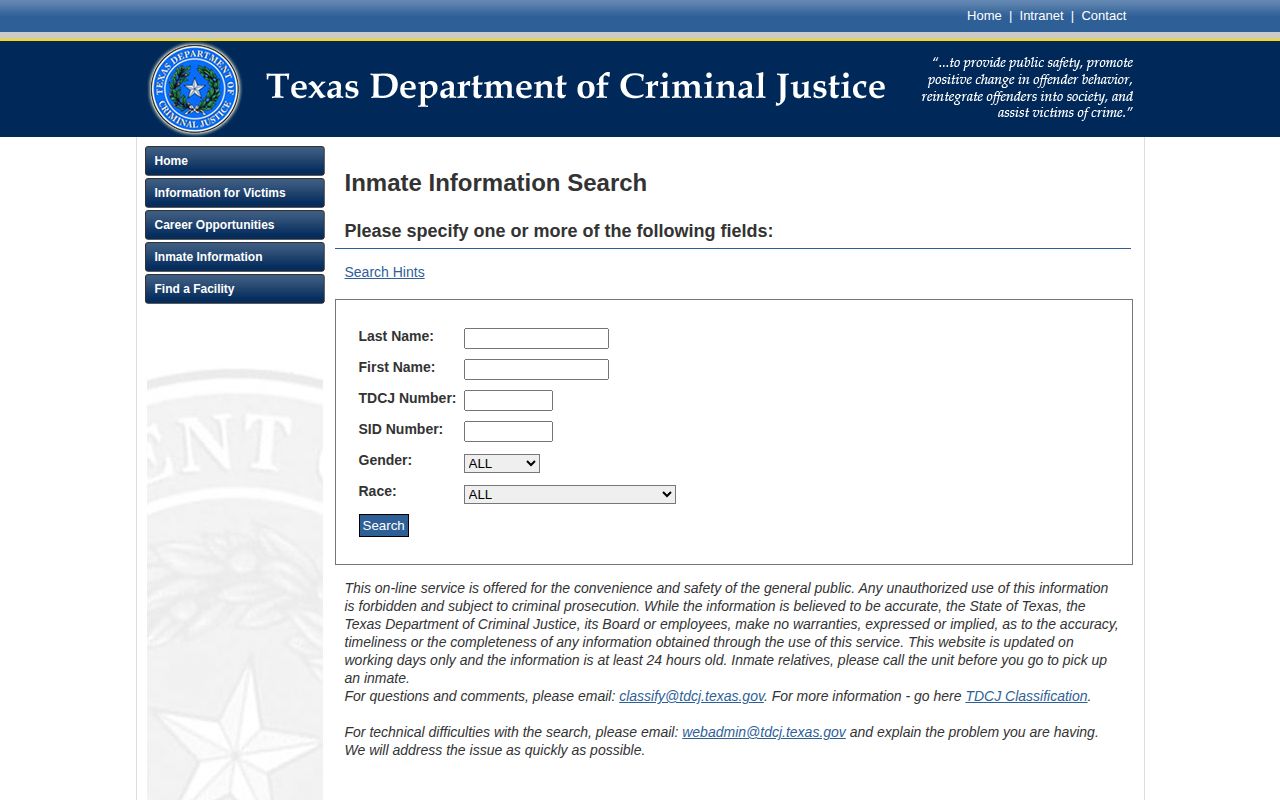
The notice limits results to people currently incarcerated in a TDCJ facility, so it cannot serve as a permanent archive of former prisoners.
Texas Good Time in Aransas County Release Dates
County and state good time are different systems. For a county-jail sentence, Texas Code of Criminal Procedure Article 42.032 authorizes the sheriff to grant good-conduct commutation for good conduct, industry, and obedience. The maximum stated rate is one day for each day actually served, subject to the article and the person's record. It is discretionary, not an automatic promise that every county sentence is cut in half.
For TDCJ, Government Code Section 498.003 calls good-conduct time a privilege rather than a right. It affects eligibility for parole or mandatory supervision and does not otherwise reduce the sentence itself. Classification, conduct, participation, forfeiture, and restoration can alter the credit balance; Section 498.004 governs forfeiture and restoration. A date copied earlier may therefore become stale.
Texas has no universal 85-percent rule for state prisoners. Section 508.145(d) generally makes people in listed serious-offense or affirmative-finding categories serve actual calendar time equal to one-half of the sentence or 30 calendar years, whichever is less, before parole eligibility, without counting good time. Section 508.145(f) generally uses calendar time plus accrued good time equaling one-fourth of the sentence or 15 years, whichever is less, for other covered cases, subject to exclusions and special rules. Eligibility is not release.
Why Aransas County Release Dates Change
A projected date is only as current as the sentence, credits, holds, and agency decisions behind it. Read the change reason from an official record instead of guessing from a date that moved online.
| Factor | Effect on the date or event |
|---|---|
| Discipline or credit change | County or state credit may be lost, forfeited, restored, or recalculated under the applicable rules. |
| New sentence or corrected judgment | A later court order can change the governing term, concurrency, or jail credit. |
| Detainer or warrant | The person may leave one custodian but transfer to another rather than enter the community. |
| BPP decision | Approval, denial, next review, or a program-conditioned vote changes the parole path but does not itself record release. |
| Mandatory-supervision review | Post-1996 qualifying cases can require discretionary review, and statutory exclusions apply. |
| Release planning | The scheduled date or location may shift, including on the displayed day. |
Note: Offense date and judgment control the applicable Texas law; sentence length alone cannot predict a valid release date.
Confirm an Aransas County Completed Release
For county custody, call the Detention Center and then request the permanent jail-register entry and booking-out record when documentary proof is needed. Ask for the recorded date and time, exit classification, legal authority, and receiving agency. This separates bond or sentence completion from a transfer to TDCJ, USMS, ICE, another county, or another facility.
For a current TDCJ prisoner, compare the state result with the judgment and any BPP decision. TDCJ's email information route at pia@tdcj.texas.gov instructions can supply listed incarceration information for a former prisoner who no longer appears in the current-only tool. After parole approval, confirm both completed release and the responsible Parole Division office.
For an Aransas County sentence, the official Detention Center page supplies the jail contact, while the county court-system guide helps identify the clerk holding the judgment. The jail entry proves physical movement; the court record explains legal authority. Neither should be forced to answer the other's role.
The TDCJ scheduled-release guidance is the source for the date-and-location warning shown below.
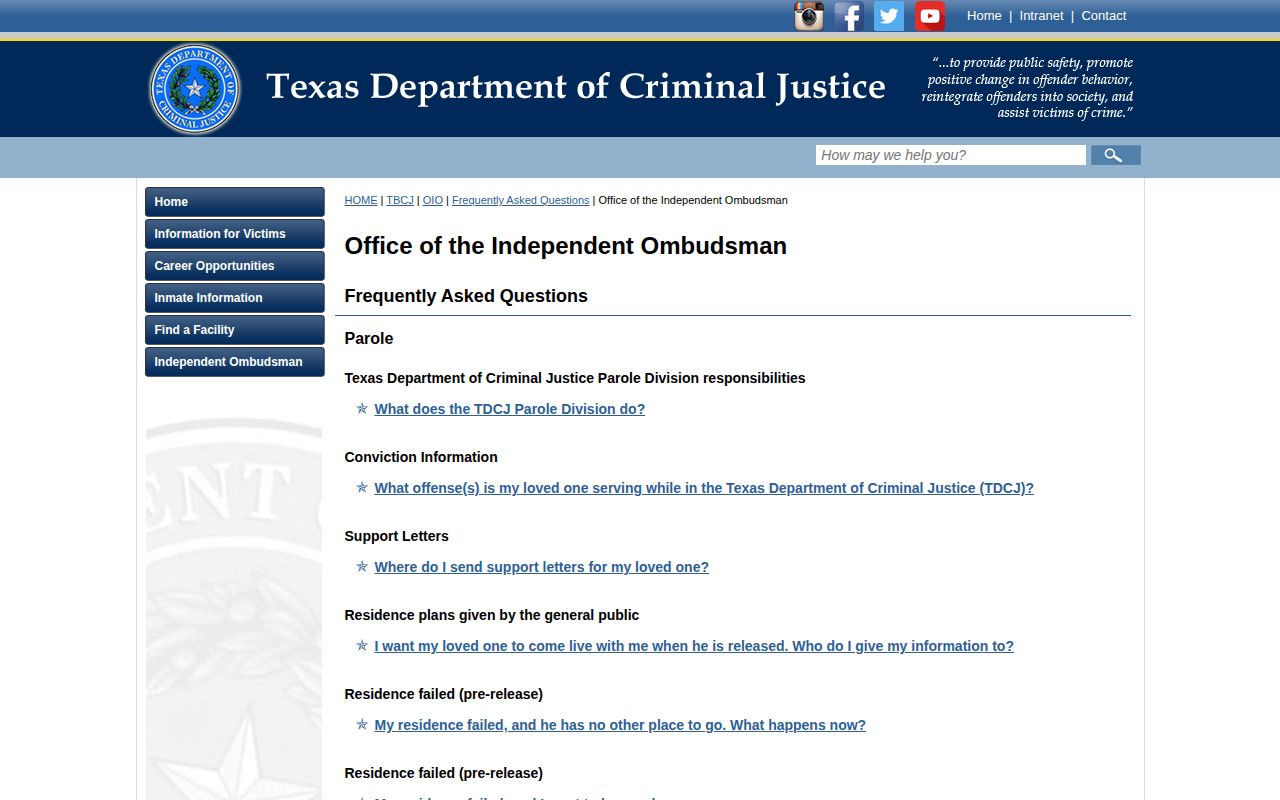
The warning is why a planned date should always be followed by a check of the actual custody event.
Texas IVSS-Counties may provide a county notification when Aransas participation and the record are available; TDCJ IVSS is separate for state custody. Alerts support timely follow-up but are not certified release records. The current notification steps are covered on the VINELink Inmate Search page.
Who Computes an Aransas County Jail Release?
The Aransas County inmate handbook directs requests for good-behavior or work credit to jail staff, not the courts, and explains that discipline can affect credit. Combined with Article 42.032, this makes the jail the source for an individual's county-sentence computation. The court remains the source for the judgment, sentence length, and credit ordered for time already confined.
Do not take the statute's maximum commutation rate and build a release date at home. Ask jail records for the calculation actually applied, then compare it with the signed judgment. If the figures conflict, identify whether the issue concerns court-awarded jail credit, sheriff-administered conduct credit, a disciplinary action, or a separate hold. Each belongs to a different record and decision maker.
The Aransas County inmate handbook provides the distinctive local instruction. Its lack of a successful manifest image does not weaken the source, but it means no substitute screenshot is used here.
County good-conduct credit should also be kept apart from TDCJ good time. Article 42.032 concerns the sheriff's county-jail authority. Chapter 498 concerns state prisoners and eligibility calculations. If the Detention Center reports that a person was committed to TDCJ, stop using the county calculation for later prison release. The county event was a transfer, and the state record becomes the correct source for later projected, scheduled, parole, mandatory-supervision, or discharge milestones.
Parole Votes Are Not Aransas County Release Dates
The Texas Board of Pardons and Paroles ordinarily considers files through sequential panel voting, not a public formal-hearing calendar. BPP decision codes must be read on their own terms. FI-1 can indicate release when eligible, while other FI outcomes may require a program. NR, SA, RMS, and DMS have different published meanings. None should be rewritten as an actual release timestamp.
The functional review schedule belongs to the individual case. Parole Division generally identifies cases in advance of initial eligibility and later reviews, but the eligibility date comes from the offense date, judgment, and applicable version of law. A favorable vote may still be followed by program work, release planning, a scheduled date, and last-minute changes. Confirm the state custody exit after those stages.
Mandatory supervision needs the same care. For qualifying offenses before September 1, 1996, TDCJ explains that a person not paroled may be released on the projected date under mandatory supervision. For qualifying later offenses, BPP review is discretionary, and Section 508.149 lists ineligible categories. If approval does not occur or the person is ineligible, the projected date may operate as the discharge date. That legal role still does not make an unpassed future date proof of release.
When sources disagree, preserve the sequence. Record the date shown by TDCJ, the date of the Board vote, any later schedule, and the completed custody event as separate facts. Ask the agency that owns each record to correct its own field. A court corrects its judgment, the jail addresses its booking and credit records, and TDCJ addresses its state calculation. This method gives an Aransas County release date a traceable basis without turning an estimate into a promise.