
Rockport Arrest Release Paths
No official source verified a separate Rockport municipal jail or a Rockport released-person archive. The Police Department is an arrest and processing agency, not a confirmed stand-alone detention facility. A person arrested by Rockport officers may have police records for the arrest and a separate Aransas County Detention Center record for booking, confinement, release, or transfer. Never describe a police no-result as proof of community release.
Municipal and county records answer different questions. Rockport Police can identify the arrest and handoff. The county jail can state whether it accepted the person and how that custody ended. Rockport Municipal Court can explain a city case or fine-only matter, while the County Court at Law or district courts may hold other causes. One person can have more than one active case, so release on one does not clear every warrant or hold.
Confirm a Rockport Release
- Ask Rockport Police whether the person was arrested and transferred to another custodian.
- Check with the Aransas County Detention Center to learn whether a county booking occurred.
- If the person left county custody, ask whether the event was community release or transfer.
- Match each cause number with the court that handled it.
- Request the completed booking-out or transfer entry instead of relying on a missing online result.
The official Rockport Police page verifies the agency but does not provide a public released-inmate search. Aransas County also has no verified recent-release feed. Use the Aransas County release-record process for the county jail portion and preserve the police-to-jail handoff as a separate fact.
If the jail reports TDCJ, USMS, ICE, or another county as the receiver, continue with that custodian. A transfer means the local hold ended while custody continued. The final description should be as narrow as the records support, such as “transferred to Aransas County,” “released on bond,” or “transferred to federal custody.”
Rockport Police Record Contacts
Use the Police Department for its arrest or incident record and the county jail for the custody record. The joint Public Safety Center is listed at 714 E. Concho Street in Rockport. The county Sheriff's main number is 361-729-2222, while the Detention Center information line is 361-790-0168. Call the relevant office before an in-person visit and ask which custodian holds the exact item.
714 E. Concho Street
Rockport, TX 78382
Official Police Department page
County custody check: 361-790-0168
A focused request should identify the person, approximate arrest date, incident or booking number if known, and the precise record sought. Ask police for arrest and transfer facts. Ask the jail for its register entry, booking-out form, release or transfer authority, event date and time, and receiving agency. This division avoids asking one office to create an account from records owned by another.
Rockport Police Versus Jail
A police station is not automatically a public jail. Research confirmed Rockport Police but did not establish a separately operated municipal detention facility, release desk, roster, or booking-photo page. The responsible way to describe a Rockport arrest is as a two-office verification path when continued confinement may have occurred. Police documents show the municipal action; county jail documents show the detention event.
This distinction also prevents false claims about release location. No source establishes that all municipal arrestees follow one fixed transport policy. Ask what happened in the individual case. If the person was cited or released by police without a county booking, there may be no county jail release record at all. If booked by the Sheriff, the county record becomes central.
Rockport Court Release Context
The Rockport Municipal Court holds applicable city ordinance and state-law matters within its jurisdiction. Fine-only cases and warrant functions can leave a docket trail even when there was no long county confinement. Read the latest signed order or docket event and then reconcile it with the arrest and jail records.
The official court route is shown below because it supplies Rockport-specific disposition context.
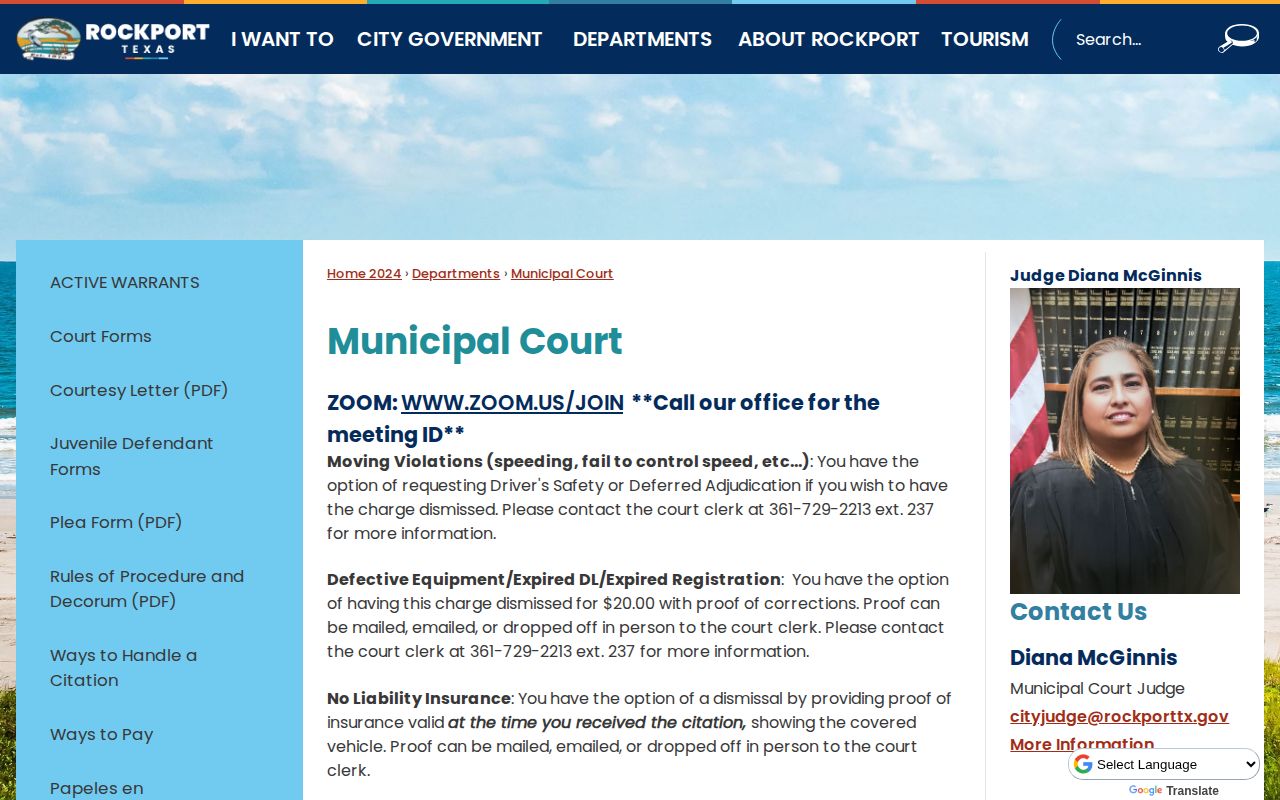
The court record explains the case result. It does not replace the Detention Center's physical release or transfer entry when a county booking occurred.
Rockport Custody Handoffs
Track each agency handoff as its own event. Rockport Police may arrest. Aransas County may book. A judge may set bond or enter another order. USMS or ICE may lodge a hold. TDCJ may later accept a sentenced prisoner. Combining these steps into one “release” hides the destination and can lead a family to the wrong office.
Begin with a binary question: is the person still physically held by the county? If not, ask for the destination. Follow TDCJ transfers through the statewide current-inmate search. Follow federal movement through the federal court and USMS, then BOP after designation. Follow immigration custody through ICE. Another-county transfers require that county's official channel.
The Detention Center visitation policy separately identifies county and federal detainees. That local fact shows why even a person first arrested in Rockport can move through more than one system. A transfer from the Aransas building is continued custody unless the receiving record proves otherwise.
Durable Rockport Release Proof
There is no verified Rockport or Aransas rolling roster archive. Texas Local Schedule PS provides the durable county fallback: the jail register, with release or transfer date, is permanent. Booking-out and release or transfer orders have a minimum retention of release or transfer plus two years. These periods describe government records, not a public web display.
Ask for both release and transfer outcomes when the destination is unknown. A date-bounded request can also distinguish people who entered the community from those delivered to another custodian. Medical, juvenile, sealed, expunged, victim-identifying, and security material may be lawfully withheld or redacted, so request the smallest set that answers the custody question.
Finish the Rockport Record Trail
Build the timeline from dated records. Start with the police arrest or citation, add the county intake if one occurred, then add the court order and jail exit. Keep transfers as separate events. This makes it possible to see whether a person entered the community or moved to a new custodian without treating a silent website as evidence.
If names or dates conflict, use booking and cause numbers to resolve the match. Report the problem to the office that created the disputed field. A police report should not be used to rewrite a jail event, and a jail entry should not be used to guess the result of a city case. The narrow, agency-by-agency trail is the soundest Rockport release record.