
TDCJ Release and Discharge
No TDCJ unit was found in Aransas County. This destination represents the statewide prison and state-jail system that may receive a person committed by an Aransas court. Transfer from the Aransas County Detention Center into TDCJ is not release. A later parole, mandatory-supervision release, or sentence discharge is a separate state event.
Parole means conditional community release for part of a sentence. Mandatory supervision is another supervised-release form governed by statute and Board review rules. Discharge means the sentence has ended. A projected or scheduled date is not a completed release. Use the exact status and confirm the actual event after the date passes.
Confirm a TDCJ Release
- Search the TDCJ current-inmate tool with a TDCJ or SID number when known, or exact last name and enough identifying information.
- Compare identifiers, conviction county, location, offenses, and Projected Release Date.
- Remember that the live tool includes only people currently incarcerated in a TDCJ facility.
- For a former prisoner, request incarceration history by email and ask for actual release or discharge information.
- If parole or mandatory supervision applies, confirm community status through BPP and the TDCJ Parole Division.
A matched current record proves present TDCJ incarceration and may explain why a person left the Aransas jail. A no-result does not prove discharge. The person may be outside the tool's current-only scope, may have been booked only in county jail, or may require better identifiers. The Aransas County release search covers the local record that precedes a state commitment.
TDCJ History Request Contact
For past state custody, email pia@tdcj.texas.gov. Put the full name in the subject and provide the seven-digit TDCJ number. If it is unknown, give an exact birth date, or approximate age plus county of conviction. Ask for the TDCJ number, incarceration history, offense, county, court, and projected or actual release information.
Inmate Information landing page
Online Inmate Search
History email: pia@tdcj.texas.gov
Parole status line: 844-512-0461
TDCJ says the basic email information service has no charge and does not provide photographs or Social Security numbers. A photograph, certified packet, or more extensive file may require a formal records route. Keep sensitive identifiers out of a request unless the agency requires them for a match.
TDCJ State Custody Scope
TDCJ holds people committed to the Texas prison or state-jail system. It is not the search for every Aransas arrest. Someone who bonded out of the county jail without a TDCJ commitment may never appear. Conversely, a matched TDCJ location shows that the county exit was a state transfer, not community release.
The online form accepts Last Name, First Name, TDCJ Number, SID Number, Gender, and Race. The minimum is last name plus at least a first initial, a TDCJ number, or an SID. Last name is exact-match. Better input reduces false no-results, but it cannot turn a current-only service into a discharged-person archive.
TDCJ Current-Inmate Search Limit
The official TDCJ search states that only people currently incarcerated in a TDCJ facility are included. The screen appears below.
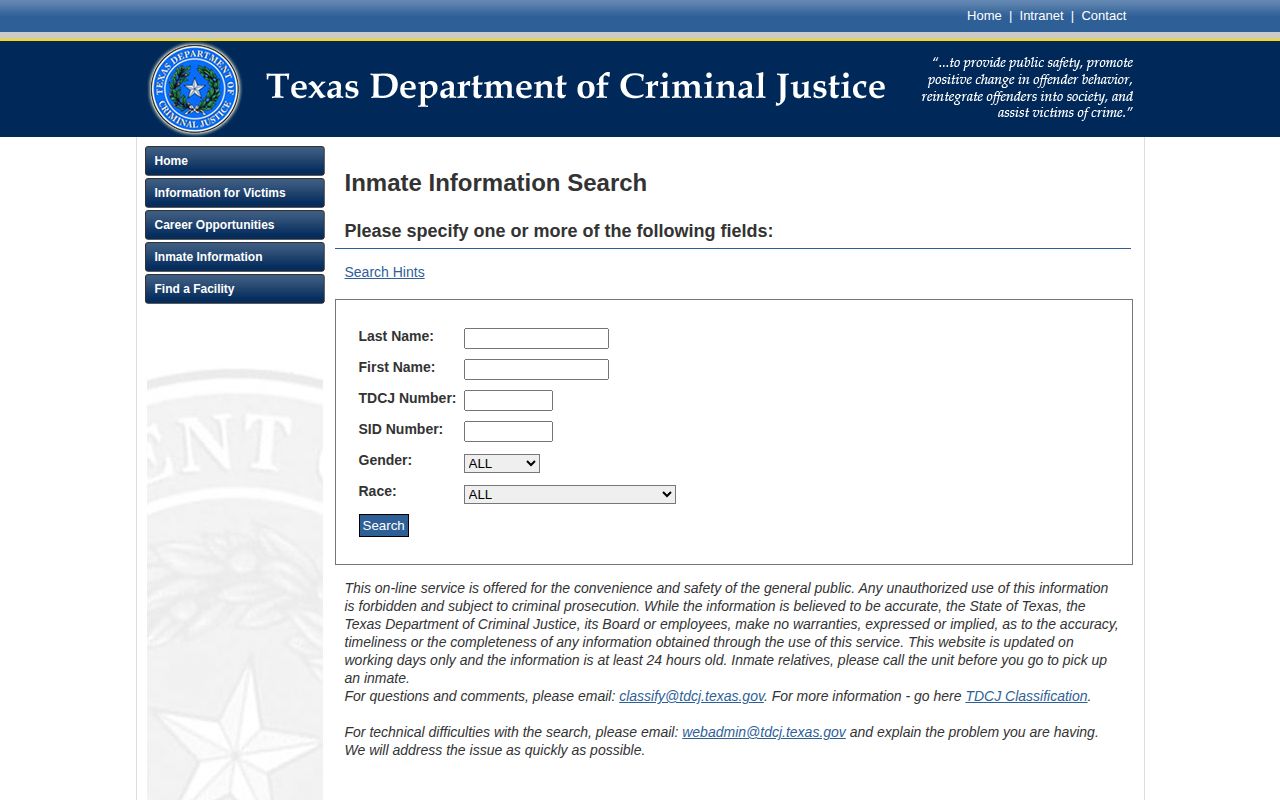
That scope makes the search useful for confirming a transfer into state custody, but not for retrieving a permanent list of discharged former prisoners.
If a former prisoner is absent, use the TDCJ history-request channel. Then reconcile the response with the Aransas judgment and county transfer entry. A state history can establish admission and release or discharge, while the local record identifies when and why Aransas custody ended.
TDCJ Projected Release Date
Projected Release Date is TDCJ's term for a calculated legal milestone. It can reflect sentence rules, time credit, mandatory-supervision law, and Board decisions. For qualifying offenses before September 1, 1996, TDCJ explains that a person not paroled may release on the projected date under mandatory supervision. For later qualifying offenses, the Board's mandatory-supervision review is discretionary. Ineligible or unapproved cases may use the projected date as the discharge date.
After parole approval and final planning, the record may show Scheduled Release Date and Scheduled Release Location. TDCJ warns both can change without notice, even on the scheduled day. Parole approval can also carry a program or eligibility condition. Confirm the completed move and resulting supervision instead of publishing a future field as an accomplished release.
The TDCJ email lookup page documents the history fallback and release-date terminology.
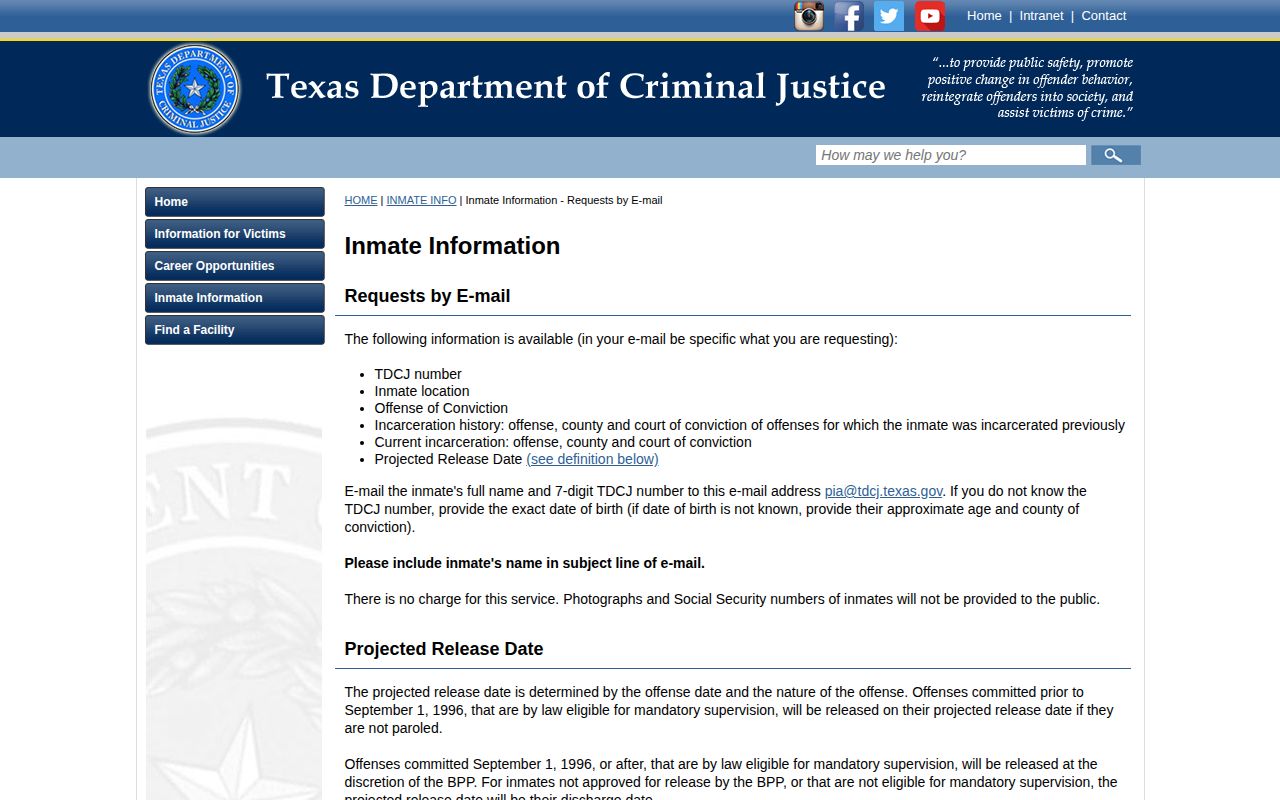
This request path is especially important after a person drops outside the online current-inmate scope.
Aransas TDCJ Parole Routing
BPP makes parole and mandatory-supervision decisions. The TDCJ Parole Division supervises people serving the rest of a sentence in the community. Aransas County routes through the Corpus Christi area. The Corpus Christi District Reentry Center serves Aransas at 422 Sunbelt Drive, Corpus Christi, TX 78408, phone 361-888-5698. A reentry center is not necessarily the assigned reporting office, so verify the person's office through Parole Division.
A Board file status must be read carefully. “In review” is not approval. A favorable vote can require eligibility, a treatment program, release planning, or resolution of a detainer. “On parole” or “on mandatory supervision” supports community release. “Discharged” means the sentence ended. The Aransas probation and parole guide explains the difference from court-imposed probation.
TDCJ Release Identification Help
TDCJ's Reentry Program includes an identification-processing phase for eligible state prisoners. It can assist with a replacement Social Security card, certified birth certificate, and state identification card at release. This is a state-prison program, not a promise that the Aransas County jail supplies those documents.
Local property documentation follows a different path. Texas Schedule PS retains county property inventories and receipts, including return of non-confiscated property, for release or transfer plus two years. A person who moved from Aransas into TDCJ may therefore need separate county property records and state reentry records.
Finish the TDCJ Release Check
Preserve the Aransas judgment and transfer record alongside the TDCJ result. The county documents explain how state custody began. TDCJ history explains admission and release or discharge. BPP and Parole Division records explain conditional community supervision. No one source should be made to answer all three stages.
If a projected date passes, check again for a completed status and request history when the person no longer appears online. Record whether the final result is parole, mandatory supervision, or discharge. Avoid converting a Board vote, scheduled location, or calculated milestone into an actual release. The verified event and resulting supervision status are the facts that matter.